Non-Governmental Organisations (NGOs) work towards creating positive changes in society through charitable activities, community development, education, healthcare, and social welfare programmes. To support these initiatives, NGOs receive financial contributions from individuals, businesses, and other institutions.
Whenever an NGO receives a donation, maintaining proper documentation is essential. An NGO donation receipt is an official acknowledgement that confirms the contribution received by the organisation. It helps donors maintain proof of their donations while allowing NGOs to manage their financial records transparently.
In India, donation receipts are also relevant for income tax documentation, particularly when contributions are made to organisations approved under Section 80G. However, tax benefits depend on the eligibility of the organisation and the nature of the donation.
Let's explore everything you need to know about NGO donation receipts, including their format, essential details, benefits, and issuance process.
Understanding the NGO Donation Receipt
An NGO donation receipt is a written or digital document issued by a charitable organisation after receiving a contribution. It confirms that the donation has been successfully received and records important transaction information.
For instance, if an individual contributes Rs 12,000 to an NGO providing free medical assistance to economically weaker communities, the organisation can issue a receipt acknowledging the contribution.
A typical NGO donation receipt includes:
-
Name and address of the NGO.
-
Unique receipt identification number.
-
Donor's name and relevant details.
-
Date of donation.
-
Amount received.
-
Payment method.
-
Transaction reference, where applicable.
-
Relevant registration and tax information.
-
Authorised representative's signature.
This documentation helps maintain transparency and makes donation tracking easier.
Importance of Maintaining NGO Donation Receipts
Donation receipts are important for both organisations and contributors. They support financial accountability and help establish a professional relationship between donors and NGOs.
1. Provides Transaction Confirmation
A donation receipt confirms that the organisation has received a contribution. Donors can use it to verify their payment details and maintain a record of their charitable contributions.
2. Supports Tax Documentation
Donations made to eligible organisations may qualify for deductions under Section 80G of the Income Tax Act. A properly issued receipt helps donors maintain supporting documents for their income tax records.
3. Strengthens Organisational Transparency
NGOs often receive contributions from different sources. Maintaining individual donation receipts makes it easier to identify incoming funds and prepare accurate financial statements.
4. Encourages Donor Confidence
Providing an acknowledgement after receiving a contribution shows that the NGO follows organised financial practices. This can encourage donors to continue supporting its activities.
5. Helps During Financial Audits
Donation receipts provide supporting evidence for accounting entries and financial transactions. They help organisations maintain organised records for audits and compliance reviews.
Sample NGO Donation Receipt Format
An NGO can create a standard donation receipt template to acknowledge contributions professionally. The following example demonstrates the information that can be included.
NGO Donation Acknowledgement
Organisation: Helping Hands Charitable Trust
Registered Address: New Delhi, India
Receipt Number: HHT/2026/015
Date: 11 November 2026
| Donation Particulars |
Information |
| Donor Name |
Priya Verma |
| Donation Amount |
Rs 12,000 |
| Amount in Words |
Twelve Thousand Rupees Only |
| Payment Method |
NEFT |
| Transaction Reference |
NEFT123456 |
| Donation Purpose |
Healthcare Support |
| Organisation PAN |
AAAAA1234A |
| 80G Approval Details |
As applicable |
Thank You Message:
We sincerely appreciate your generous contribution to Helping Hands Charitable Trust. Your support enables us to continue our charitable initiatives and serve communities in need.
Authorised Signatory
Helping Hands Charitable Trust
This is a sample format. Organisations should use their actual details and include tax-related information only when applicable.
What Details Should Be Included in an NGO Donation Receipt?
A complete donation receipt should provide enough information to identify the organisation, donor, and contribution.
The following information should be considered while preparing the document:
| Receipt Element |
Explanation |
| Organisation Name |
Official registered name of the NGO |
| Registered Address |
Official communication address |
| Receipt Number |
Unique number assigned to the receipt |
| Issue Date |
Date the donation is acknowledged |
| Donor Information |
Name and other required details |
| Donation Value |
Contribution amount in figures and words |
| Payment Details |
Cash, cheque, UPI, or bank transfer |
| Transaction ID |
Reference for payment verification |
| PAN Information |
Relevant tax identification details |
| Registration Details |
Applicable registration information |
| 80G Information |
Approval details, if the NGO is eligible |
| Signature |
Authorisation by the organisation |
Accurate information helps avoid discrepancies and improves the reliability of financial documentation.
Different Methods of Issuing NGO Donation Receipts
NGOs can issue donation receipts in different formats depending on how contributions are received.
Printed Donation Receipts
Printed receipts are physical documents provided to donors after receiving their contributions. They are commonly used when donations are collected directly through fundraising events, community programmes, or local campaigns.
Digital Donation Receipts
Digital receipts are generated electronically and shared through email or messaging platforms. They are useful for organisations receiving contributions through online fundraising campaigns.
Bank Transfer Receipts
When donations are received through banking channels such as NEFT, RTGS, or IMPS, organisations can issue receipts containing the relevant transaction information.
UPI Donation Receipts
UPI payments have made small and frequent donations easier. NGOs can generate receipts after verifying successful transactions and recording the relevant payment reference.
80G Donation Receipts
Organisations with valid Section 80G approval can provide the relevant donation documentation to donors who make eligible contributions.
How to Prepare an NGO Donation Receipt Step by Step
Preparing an accurate donation receipt requires proper verification and record-keeping.
Step 1: Record the Donor's Details
Collect the donor's name and other information required for the organisation's records and applicable tax reporting.
Step 2: Confirm the Contribution
Verify the actual amount received through the relevant payment method. Do not issue a confirmed payment receipt based solely on an unsuccessful or pending transaction.
Step 3: Create a Receipt Identification Number
Assign a unique receipt number to every contribution. Maintain a sequential numbering system to make future verification easier.
Step 4: Enter Payment Information
Mention the donation amount, payment date, payment method, and transaction reference wherever relevant.
Step 5: Check Registration and Tax Details
Verify the NGO's registration information and include Section 80G approval details only if the organisation is eligible.
Step 6: Issue the Receipt
Generate the final document and provide it to the donor through a suitable communication channel.
Step 7: Store the Receipt
Maintain a copy in the organisation's accounting records for future reference, reconciliation, and reporting.
NGO Donation Receipt and Income Tax Benefits Under Section 80G
Section 80G is an important provision of India's Income Tax Act that allows deductions for certain donations made to approved funds and charitable institutions.
Donors should understand that donating to any NGO does not automatically make the contribution eligible for a tax deduction.
The following conditions are important:
-
The receiving organisation must have valid Section 80G approval.
-
The donation must qualify under the relevant provisions.
-
Cash donations exceeding Rs 2,000 are not eligible for deduction.
-
The deduction percentage depends on the category of the approved institution.
-
Some eligible donations qualify for 100% deductions, while others qualify for 50%, subject to applicable limits.
-
Donations in kind generally do not qualify for Section 80G deductions.
Eligible NGOs must also follow applicable reporting requirements, including filing Form 10BD and issuing Form 10BE to donors where required.
Donors should verify the organisation's approval status and applicable tax rules before claiming deductions.
Advantages of Digital Donation Receipt Management
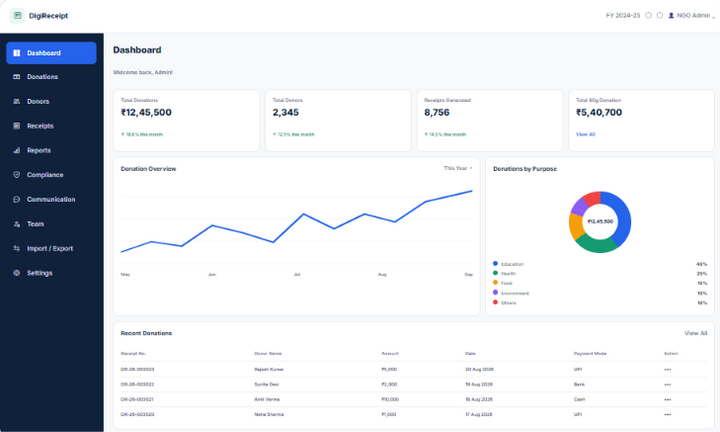
Managing donations manually can become difficult when an NGO receives contributions from a large number of donors. Digital documentation can simplify this process.
Some major advantages include:
Faster Processing: Digital systems make it easier to prepare and distribute donation receipts.
Centralised Records: Organisations can maintain donation information in one organised system.
Improved Accuracy: Standardised templates reduce the chances of incorrect entries.
Easy Verification: Payment references make it easier to match donations with bank transactions.
Reduced Administrative Costs: Electronic records reduce printing and paperwork expenses.
Convenient Access: Authorised team members can retrieve receipts whenever required.
Common Errors to Avoid in NGO Donation Documentation
Even small documentation mistakes can create problems during accounting and financial verification. NGOs should avoid the following:
-
Using incorrect receipt numbers.
-
Recording inaccurate donation amounts.
-
Issuing receipts before verifying payments.
-
Entering incorrect donor details.
-
Mentioning tax benefits without valid 80G approval.
-
Not maintaining transaction references.
-
Failing to organise digital and printed records.
-
Not reconciling donation collections with bank statements.
A proper donation management process can help organisations maintain accurate records and improve accountability.
Conclusion
An NGO donation receipt plays an important role in maintaining financial transparency, acknowledging donor contributions, and supporting proper accounting practices. It provides donors with written confirmation of their contributions and helps organisations maintain organised financial documentation.
Whether donations are received through cash, UPI, bank transfers, or online fundraising platforms, NGOs should follow a consistent receipt-generation process. Using standardised templates and digital record-management systems can make donation administration faster and more efficient.
Most importantly, NGOs should ensure that all registration and tax-related details are accurate and that Section 80G benefits are communicated only when the required approval and eligibility conditions are satisfied.
Frequently Asked Questions (FAQs)
1. What is an NGO donation receipt?
An NGO donation receipt is an official acknowledgement issued by an NGO to confirm that it has received a donation from an individual or organisation.
2. Why is a donation receipt important for NGOs?
It helps NGOs maintain financial records, acknowledge donor contributions, support accounting activities, and demonstrate transparency.
3. Can an NGO provide a donation receipt for online payments?
Yes. NGOs can issue digital receipts for contributions received through UPI, net banking, debit cards, credit cards, and online payment gateways.
4. Does every NGO donation qualify for an 80G deduction?
No. Only donations meeting the applicable Section 80G requirements and made to eligible approved organisations can qualify for deductions.
5. What is the difference between an NGO donation receipt and an 80G certificate?
A donation receipt acknowledges the contribution, whereas Form 10BE is the prescribed certificate provided to eligible donors under the applicable Section 80G reporting requirements.
6. Can an NGO issue a receipt for donations received in cash?
Yes, subject to applicable legal requirements. However, cash donations exceeding Rs 2,000 are not eligible for Section 80G deductions.
7. What information is required for an NGO donation receipt?
It generally includes the NGO's name, address, receipt number, date, donor details, donation amount, payment method, and applicable registration information.
8. What is Form 10BD?
Form 10BD is a prescribed statement of donations received that eligible charitable organisations must submit to the Income Tax Department.
9. Can businesses receive donation receipts from NGOs?
Yes. NGOs can issue receipts to companies and other business entities that contribute towards eligible charitable activities.
10. How can an NGO maintain donation receipt records?
An NGO can use accounting software, digital receipt templates, spreadsheets, and organised financial documentation to track donations and maintain accurate records.
 Venues